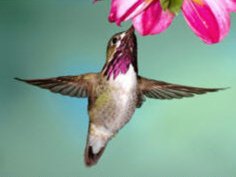
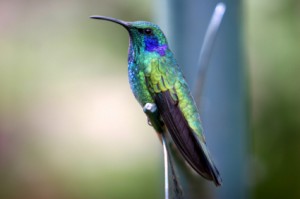
The Green Violet Eared Hummingbird can be found at elevations as high as 13,000 feet. This is a tropical species of hummingbird which is known to breed from Mexico south to Bolivia.
Here is a fact about the Green Violet Eared Hummingbird that you will most likely find quite surprising. I know this information was completely unexpected to me. There have been two to documented occurrences of the Green Violet Eared Hummingbird in the North Carolina mountains. One took place in Asheville in late October of 1987. The other occurred in Burnsville in September of 1995.
The factual information for this post came from the North Carolina Museum of Natural Sciences. I wish to give proper credit for this information.
A hummingbird must feed frequently or about every 10 minutes. They will feed on nectar, from flowers as well as feeders, as well as small insects such as spiders, flies and more.
Have you every wondered how many flower blooms a hummingbird visits per day? The answer many surprise you. One research study recorded an Anna’s Hummingbird visiting 1,000 flower blooms per day.
Hummingbirds are not born with an innate preference for the color red. Each hummingbird must learn the association between the red flowers and the fact that these flowers are a food source. Does this surprise you? It certainly did me.
A hummingbird can drink up to twice their body weight in nectar per day. This is far more then other species of birds which normally drink between 1/4-1/2 of their body weight per day.
Have you ever wondered what can cause hummingbirds to fight each other? If so, then this post will offer you some insight as to why this occurs.
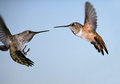
Hummingbirds will fight to protect their food source or to guard and defend their territory. The birds will use their bills and claws as weapons. Sometimes, the birds may even collide with one another.
It is quite rare for a hummingbird to be injured during a fight, because their instincts tell them not to risk injuring their bills. Amazingly enough, hummingbirds fight less whenever food is scarce. I was unable to find out a reason for this in any of the sources I read while researching this topic.
Hummingbirds do not attack humans, but they have been known to get within inches of someone’s face. This experience can indeed be frightening.
As I said before, a hummingbird will fight to defend its territory. Both the male and female each establish their own territory. The female’s territory is where the nest will be built and where the young will be feed. The male’s territory is a way for the male to protect a reliable food source. The male does not take any responsibility for the building of the nest or for the care and feeding of the young. If a female hummingbird enters a male hummingbird’s territory, he will perform aerial displays to keep her away. It is so important to both the sexes that individual territories be maintained that the act of mating takes place on neutral ground.
While it is impossible to try and explain every possible reason why hummingbirds fight, it is my sincere desire that this post will have provided some insight into this topic. Maybe you will understand better why there is often a fierce battle of the various hummingbirds at your feeders.
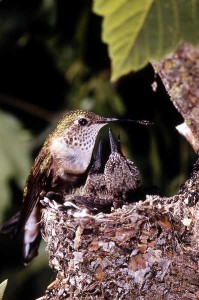
Chances are you have never before seen a hummingbird nest, so I thought you might enjoy being able to see one through this photo.
The nest in this photo actually looks quite large to me, but looks can indeed be deceiving. A hummingbird nest is generally the size of a pea or half a walnut shell.
Most hummingbird nests are made of lichens, moss and fragments of bark, bound together with strands of spider web and lined with soft downy plant material like cottonwood fluff.
The Anna’s Hummingbird is the most common hummingbird found in Southern California. it was originally only found on the Pacific slope from Baja California to San Francisco. This bird has increased its population and expanded its breeding range in recent years to Vancouver, British Colombia, east to southern Arizona. The expansion is believed to be explained by the introduction of exotic flowering plants, especially Eucalyptus, red-hot-poker and tree tobacco,and by the proliferation of hummingbird feeders.
Here are a few more facts about the Anna’s Hummingbird. They have an unusually early breeding season. It is believed that the gooseberry plant and the hummingbird have evolved together, which may help explain why the red gooseberry is a favorite native food source of the Anna’s Hummingbird. This species of hummingbird also consumes more insects than any other North American hummingbirds, catching small flying insects on the wing in the manner of a flycatcher, or by hover-gleaning among the leaves and twigs of trees. Or they find sustenance at the sap wells of sapsuckers or by pilfering insects from the webs of spiders. The Anna’s Hummingbird eats more arthropods than most hummingbirds.